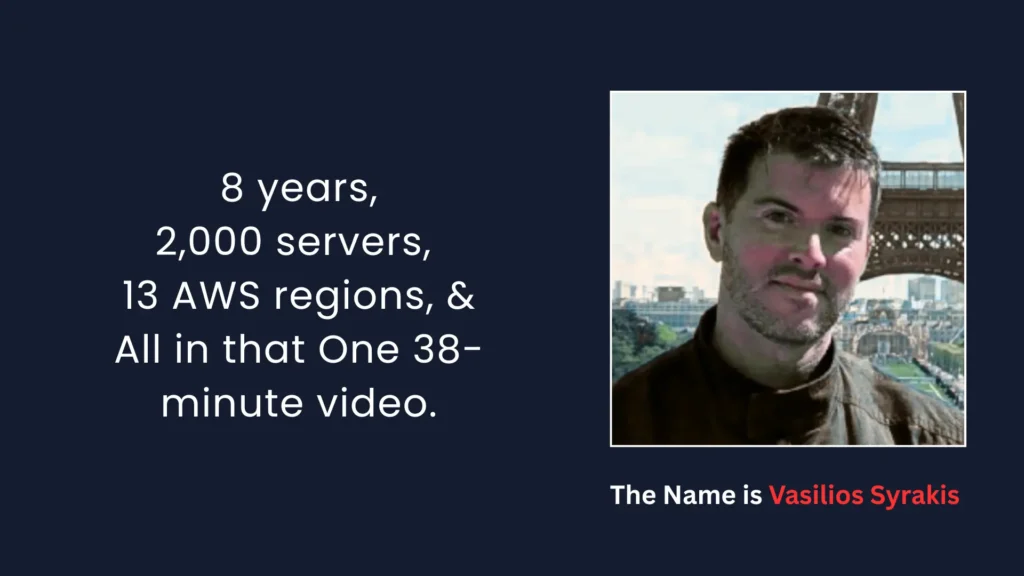
There are two kinds of people in tech. Those who leave quietly — updating their LinkedIn, refreshing job boards, grinding LeetCode in silence. And then there’s Vasilios Syrakis.
When Atlassian handed him a layoff notice in March 12, 2026 after nearly eight years of building the backbone of their cloud infrastructure, he did something nobody expected. He sat down, hit record, and uploaded a 38-minute YouTube video walking the entire internet through the systems he’d spent close to a decade constructing. No rage. No exposé. Just an extraordinarily detailed, honest breakdown of how one of the world’s biggest enterprise software companies actually runs under the hood.
The video crossed 1.1 million views in eight days. The tech world paid attention — and rightfully so.
Who Is Vasilios Syrakis?
Vasilios Syrakis is a Greek senior systems engineer who built his career deep inside Atlassian’s edge infrastructure team. Not the kind of team that gets spotlighted at product launches. Not the team pushing polished UI updates or building AI demos for keynotes. His team kept Atlassian’s enterprise-grade internet plumbing from falling apart — the kind of work that only gets noticed when something breaks at 3 AM.
He joined Atlassian at a point when the company was scaling aggressively, and over eight years he moved from building individual systems to owning large-scale infrastructure projects that touched virtually every product Atlassian shipped. Thousands of servers. Thirteen AWS regions. Dynamic proxy management across a massive distributed system.
This wasn’t a guy coasting to retirement. He was actively building, mentoring interns, training teammates, and navigating the organizational complexity that comes with being a senior engineer at a multi-billion dollar company.
Why Vasilios Syrakis Is Famous
He turned a layoff into one of the most valuable free engineering resources the internet has seen in years.
But the fuller picture is more interesting. Vasilios Syrakis became famous not because he leaked secrets or went on a public rant — he did neither. He became famous because he chose transparency at a moment when most people choose silence, and what he had to share was genuinely worth listening to.
When Atlassian announced it was cutting roughly 10% of its workforce — around 1,600 people — to fund its pivot toward artificial intelligence, Syrakis was among those let go. The company was reporting $1.79 billion in revenue that quarter. The math felt brutal to a lot of engineers watching from the outside.
His response reframed the whole conversation. Instead of making the story about the layoff, he made it about the work. He walked viewers through the systems he built, the decisions behind them, the tradeoffs he had to make, and the lessons that don’t usually make it into blog posts or conference talks. The internet had been waiting for exactly that kind of content without knowing it.
What Vasilios Syrakis Actually Built at Atlassian
This is where the story gets genuinely technical — and genuinely impressive.
The Open Service Broker:
His first major project at Atlassian was an Open Service Broker: a web application that let internal developers at Atlassian provision their own load balancers without having to file a ticket with the infrastructure team. Before this, every request went through the ops team. After it, developers could self-serve. That kind of tooling sounds small from the outside. Inside a company like Atlassian, it’s the difference between teams moving fast and teams waiting in queue.
Replacing Enterprise Load Balancers With Envoy:
The bigger project came later. Atlassian was running expensive enterprise load balancers — the kind of hardware or licensed software that costs a fortune at scale. Syrakis was part of the effort to replace them with Envoy, an open-source proxy tool originally built at Lyft. The replacement wasn’t just a cost play; it was a fundamental shift in how the company managed traffic across its entire infrastructure.
To make Envoy work at Atlassian’s scale, he built a management server that kept every Envoy instance dynamically configured across the whole fleet. That server — which he later open-sourced under the name Sovereign — handled dynamic templating and abstracted away the complexity for internal teams so they didn’t have to touch raw Envoy config files.
The Scale of What He Managed:
Around 2,000 proxy servers running across 13 AWS regions. Each one built and deployed using HashiCorp Packer and SaltStack — automated, repeatable, code-driven. No manual setup. No configuration drift. The kind of system that, when it works well, nobody talks about it. Which is exactly the problem with infrastructure engineering: your best work is invisible.
The Vasilios Syrakis YouTube Video — What Makes It Different
Most engineers who get laid off don’t document what they built. Partly because of NDAs. Partly because they’re exhausted. Partly because it’s hard to know where to start.
Syrakis started from the beginning and didn’t stop until it made sense. You can find his content on his YouTube channel under @vsyrakis.
What separates his video from a typical tech talk is the intent. He wasn’t trying to impress a future employer. He wasn’t pitching a course or a newsletter. He said, plainly, that he wanted to reflect on his work and potentially help engineers in similar situations understand what large-scale infrastructure actually looks like from the inside.
The result is essentially a system design masterclass disguised as a personal story. It covers architecture decisions, engineering tradeoffs, and the soft skills — diplomacy, conflict navigation, knowing when to push and when to let something go — that textbooks never teach but that determine whether a senior engineer survives or thrives in a large organization.
After the video went viral, the follow-up questions poured in. People wanted to know about NDAs (he addressed it). His educational background (he addressed that too). His future plans. He answered them in a second video with the same directness that made the first one land so well.
What Vasilios Syrakis Offers to the Engineering Community
Beyond the story, the practical question is: what does someone actually walk away with after following his work?
A few things stand out.
First, a realistic picture of senior engineering. Not the sanitized version from interview prep content, but the actual day-to-day of managing infrastructure at scale — the late-night incidents, the architectural decisions that outlive your tenure, the organizational politics that shape what gets built and what gets shelved.
Second, a mental model for self-service infrastructure. The work he did with the Open Service Broker and Sovereign solves a problem almost every engineering org hits at some point: how do you let teams move fast without creating chaos? His approach — abstract complexity into tooling, automate the repeatable stuff, open-source what others can use — is a playbook worth studying.
Third, and maybe most importantly: a model for how to leave a job with your head held up. He demonstrated that the knowledge you accumulate at a company doesn’t have to disappear when you do.
The Bigger Picture
Vasilios Syrakis Atlassian story sits at an uncomfortable intersection that a lot of engineers are navigating right now. Companies generating record revenue. Mass layoffs justified by AI investment. Decade-long contributors shown the door.
His response didn’t change any of that. But it did something else. It reminded the engineering community that the work matters — even when the institution decides it doesn’t need you anymore. And that sharing what you know is one of the most durable things you can do.
FAQs
Q1 : Who is Vasilios Syrakis?
Vasilios Syrakis is a Greek senior systems engineer who spent nearly eight years at Atlassian building edge infrastructure, including the Sovereign Envoy control plane and internal self-service load balancer tooling.
Q2: Why is Vasilios Syrakis famous?
He went viral after posting a 38-minute YouTube video breaking down the infrastructure he built at Atlassian following his layoff — the video hit 1.1 million views in eight days.
Q3: What is the channel name of Vasilios Syrakis on YouTube?
His YouTube channel handle is @vsyrakis.
Q4: What solution doe Vasilios Syrakis provide?
Through his videos, he provides engineers with honest, practical insight into large-scale cloud infrastructure, system design decision-making, and what senior engineering work actually looks like inside a major tech company.