
Technology
Who Is Kunal Shah? The Entrepreneur Behind CRED's Rise
By Vedant• June 24, 2026 • 8 min read
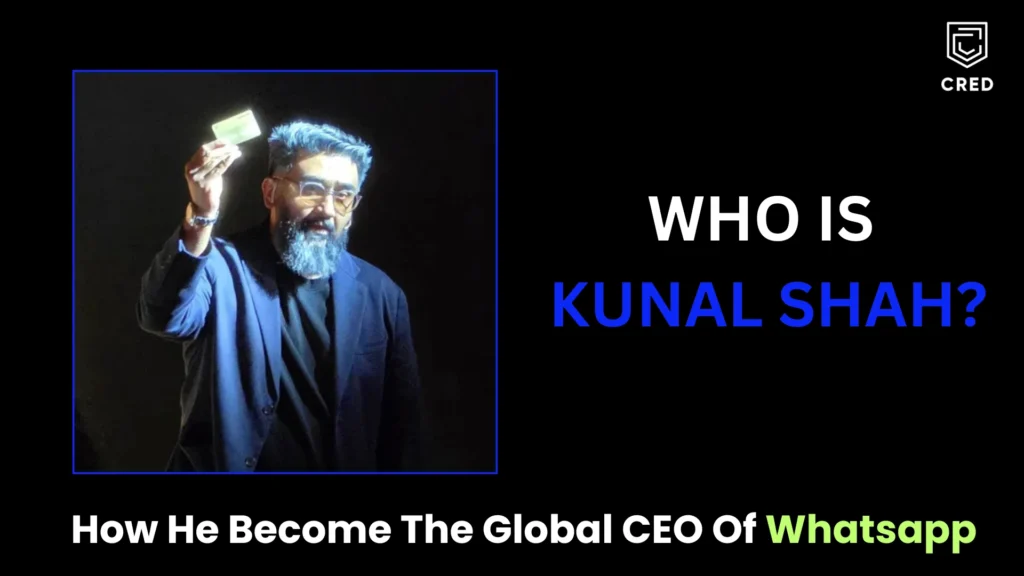
Kunal Shah is a known fintech entrepreneur in India. He co-founded FreeCharge. Helped build CRED into a huge platform. In June 2026 he became the head of WhatsApp after Meta invested a lot of money. $900 Million.
His story is different from others. It is not about going to a college or knowing important people. Instead it is about working and becoming successful on his own. He started with trying to survive and ended up creating a lasting legacy.
Kunal Shah Early Life: Hustle Before the Headlines
Born on 30 May 1979 in Mumbai, Kunal Shah grew up in a Gujarati business family. His father ran a small wholesale pharmaceutical business. When the family faced financial hardship, Kunal stepped up early. At just 15, he was already delivering packages, doing data entry work, and taking on freelance design gigs — not for pocket money, but to help keep things running at home.
Education, for him, was a tool rather than a passion. He chose to study Philosophy at Wilson College in Mumbai, not because he loved the subject, but because classes ended by 10 a.m. That left the rest of his day free to work. It was a calculated decision from someone who had learned early that survival required prioritising time well.
He later enrolled in a part-time MBA programme at the Narsee Monjee Institute of Management Studies (NMIMS). However, he dropped out in 2004 to chase entrepreneurship full-time. Despite holding no formal technical degree, he went on to build billion-dollar companies. His educational background — a BA in Philosophy and an incomplete MBA — actually shaped his famous first-principles thinking. He approached business problems analytically, stripping away assumptions and focusing on core human behaviour.
Before FreeCharge, he founded PaisaBack in 2009, a cashback promotions company. That early experiment with consumer incentives laid the intellectual groundwork for everything that followed.
Kunal Shah Education: Why a Philosophy Degree Built a Fintech Empire
His story is different from others. It is not about going to a college or knowing important people. Instead it is about working and becoming successful on his own. He started with trying to survive and ended up creating a lasting legacy.
Many people talk about Kunal Shah’s education. He studied Philosophy at Wilson College in Mumbai. He did not go to a college like IIT or IIM.. His way of designing products has worked really well. He uses data. Understands how people behave.
Studying Philosophy helped him question things, understand why people do things and think about how everything works. These are precisely the skills that make a great product builder. His famous “Delta 4 Theory” — the idea that a product must create such a dramatic improvement in user experience that going back feels impossible — is pure philosophical reasoning applied to consumer tech.
Alongside CRED, he has also shared his frameworks publicly through interviews, X (formerly Twitter) threads, and talks. That intellectual generosity has given him a cult-like following among Indian founders and investors alike.
FreeCharge Exit: The ₹2,800 Crore Milestone That Changed Everything
In 2010, Kunal Shah co-founded FreeCharge with Sandeep Tandon. The platform offered digital mobile recharges and utility bill payments through a cashback rewards model — a genuinely novel concept in India at the time. It scaled rapidly, riding the early wave of India’s digital payments boom.
Then came the exit that put his name on every founder’s radar. In April 2015, Snapdeal acquired FreeCharge in a cash-and-stock deal reportedly worth around ₹2,800 crore (approximately $400–450 million). At that point, it was one of the largest startup acquisitions India had ever seen. Furthermore, the deal validated what many sceptics had doubted — that a rewards-based payments model could command serious enterprise value.
After the acquisition, Axis Bank later bought FreeCharge from Snapdeal for approximately $60 million, reshaping its journey in the fintech space. Meanwhile, Kunal stepped back from daily operations and spent the next couple of years deeply studying consumer behaviour, trust systems, and incentive design. That period of reflection directly seeded the idea that became CRED.
Founding CRED: Building India’s Most Influential Fintech Platform
In 2018 Kunal Shah started CRED. It is a platform that rewards people for paying their credit card bills on time. At first it seemed like an idea. Why would people need to be rewarded for doing something they are already required to do? However, Kunal understood something deeper: high-credit-score individuals are underserved by conventional loyalty programmes despite being the most financially responsible consumers in the country.
CRED uses credit scores to identify eligible users, making it exclusive by design. That exclusivity became its greatest marketing asset. Over time, the platform expanded far beyond bill payments. Today, CRED operates across UPI payments, peer-to-peer money transfers, rent payments, short-term lending, insurance, wealth management, and commerce.
Between 2019 and 2025 CRED grew to have around 17 million members who used it every month.
- It got over $900 million from investors around the world.
- The company made ₹2,735 crore in revenue in FY25.
- It also reduced its losses to ₹298 crore.
CRED now processes, than 40% of India’s total credit card bill payments. This shows how big and successful the platform has become.
Kunal Shah Net Worth: What Is He Actually Worth?
Kunal Shah’s net worth is something that people talk about a lot. This is because most of his money is in markets. We do not have a public figure for his net worth. However most people think that in 2026 Kunal Shah’s net worth is around ₹15,000 crore, which’s about $500–600 million. Some people even think it could be closer to $2 billion when we look at all of his investments. The main reason Kunal Shah has much money is because he owns a part of CRED.
Reports suggest he holds roughly 10.8–12% of the company. At CRED’s peak valuation of $6.4 billion, that stake alone was worth approximately $691–749 million. After the value of CRED was reset to $3.5 billion in 2025 we had to adjust the numbers. Kunal Shah also has a lot of investments that add to his money. What is really interesting is that even though Kunal Shah has a lot of money he only takes a salary of ₹15,000 from CRED every month. This shows that he believes in the value of CRED in the run rather than just taking a lot of money now. He tells founders that they should think like this too.
Major Investments: Building One of India’s Largest Angel Portfolios
After Kunal Shah sold FreeCharge he started investing in a lot of companies. By 2021 he had already invested in more than 200 startups. As of 2026 Kunal Shah has invested in 300 companies in India, Southeast Asia, the United States and Europe.
Why is Kunal Shah famous among founders? Partly because of CRED, but equally because of the quality and breadth of his investment portfolio. His most notable bets include:
- Razorpay — now valued at over $7.5 billion, one of India’s top payments infrastructure companies
- Unacademy — an edtech unicorn that peaked at a $3.4 billion valuation
- BharatPe — a merchant payments platform that became a unicorn
- Shiprocket — a logistics aggregator now valued in the billions
- Khatabook — a digital bookkeeping platform for small businesses
- Udaan — a B2B commerce platform
- Jupiter — a next-generation consumer banking app
- Groww — a retail investing platform that went public
In total, his portfolio includes at least 11 unicorns. His investment thesis centres on companies solving problems in high-trust, high-value categories — particularly fintech, consumer internet, and increasingly artificial intelligence. He typically writes early-stage cheques in the range of $10,000–$50,000, maintaining a high-volume, low-friction model that gives him access to a wide number of cap tables without concentrated risk.
By 2022, Mint had already ranked him among India’s most active angel investors by deal volume. That pace has only accelerated since.
Kunal Shah CRED and WhatsApp: Why Did Meta Invest $900 Million?
The announcement came in June 2026 and immediately dominated tech headlines across the world. Meta invested $900 million (approximately ₹8,550 crore) in CRED, acquiring an estimated 20% stake and valuing the company at roughly $4.5 billion on a post-money basis. Simultaneously, Meta named Kunal Shah as the global head of WhatsApp, replacing outgoing chief Will Cathcart after nearly seven years of leadership.
Why This Deal Makes Strategic Sense
The $900 million investment is not simply a bet on CRED. It is not about the money, it is about filling a gap in Meta’s plans for India. WhatsApp has more than 3.3 billion users all over the world and more than 500 million users in India. However WhatsApp Pay is not as popular as PhonePe and Google Pay, in India.
Kunal Shah’s entire career has been about understanding Indian consumer behaviour around money, trust, and incentives. That experience is precisely what WhatsApp needs. Furthermore, Meta is aggressively pushing into AI-driven commerce and financial services. Shah’s background in building trust-based consumer fintech gives him a rare perspective on how to execute that vision at scale.
According to reports, the deal emerged from an unexpected cold email. Meta’s Chris Cox reached out to Kunal, and what followed led to one of the most surprising leadership appointments in global tech in recent memory.
Shah has publicly stated that CRED is ready for its next phase and that he is stepping back from his operating role while remaining a shareholder. He described WhatsApp’s future potential as “substantial” — a characteristically understated way of signalling that he sees a genuinely transformative opportunity ahead.
The Bigger Picture: Why Kunal Shah’s Journey Matters
Kunal Shah’s story resonates because it does not follow the standard template. He did not graduate from a top-tier engineering school, did not come from a privileged background, and did not raise his first round from a famous VC. Instead, he hustled, thought deeply, failed forward, and built patiently.
His famous Delta 4 Theory has become a framework taught in startup communities across India. His public writing on consumer psychology, trust, and wealth has shaped how a generation of Indian founders think. Moreover, his consistent willingness to back early-stage founders has made him a trusted name in the ecosystem long before WhatsApp entered the picture.
At every stage — FreeCharge, CRED, his angel portfolio, and now WhatsApp — the common thread is a sharp understanding of what makes humans exchange value with each other. That insight, developed during years of delivering packages and doing data entry in Mumbai, is the real engine behind his rise.
From a teenager working to support his family, to the global head of one of the world’s most used platforms — Kunal Shah’s journey is still being written. And if his track record is any guide, the most interesting chapters are almost certainly ahead.
FAQS
Q1. Who is the CEO of WhatsApp?
The CEO of WhatsApp is Kunal Shah, as of June 2026. He took the place of Will Cathcart, who was the CEO of WhatsApp since 2019.
Q2. Why is Kunal Shah famous?
Kunal Shah is famous for co-founding FreeCharge — sold to Snapdeal for ₹2,800 crore in 2015 — and for founding CRED in 2018, a members-only fintech platform that now processes over 40% of India’s credit card bill payments.
Q2. What is Kunal Shah’s net worth?
Kunal Shahs net worth is around ₹15,000 crore. This is $500 to $600 million. He has this money because of the shares he owns in CRED. He also made money when he sold FreeCharge.. He gets money from the companies he has invested in. There are 300 companies. Some of these companies are very big, like Razorpay and Shiprocket. Kunal Shah has invested in these companies.
Q3. What is Kunal Shah’s educational qualification?
Kunal Shah studied Philosophy at Wilson College in Mumbai. He got a Bachelors degree from there. He also tried an MBA Programme at NMIMS.
See Also
Related Posts
Who Is Kunal Shah? The Entrepreneur Behind CRED’s Rise
He dropped out of NMIMS, sold FreeCharge for ₹2,800 crore,...
Read More
Meta Invests $900 Million in CRED: What the Deal Means for India’s Fintech Future
Meta just bought a 20% stake in CRED for $900M....
Read More
SpaceX Buys Cursor AI for $60 Billion: What the Deal Means for Developers
Elon Musk's SpaceX is acquiring Cursor AI for $60 billion...
Read MoreCategory
Recent Posts

How to Start Budgeting: Top 10 Methods for Beginners in 2026
From the 50/30/20 rule to automating savings — these proven...
Read More
Why Big Tech Companies Are Investing in Fintech Startups in 2026
Discover why big tech companies are investing in Fintech Startups...
Read MoreWho Is Kunal Shah? The Entrepreneur Behind CRED’s Rise
He dropped out of NMIMS, sold FreeCharge for ₹2,800 crore,...
Read MoreMeta Invests $900 Million in CRED: What the Deal Means for India’s Fintech Future
Meta just bought a 20% stake in CRED for $900M....
Read More
Vedant
Vedant is the SEO and Content Writing expert having more than 4 year’s experience and founder of NexBloggy, where he shares insightful and easy-to-understand content across astrology, technology, finance, health, and entertainment. With a strong focus on research-driven writing, he aims to simplify complex topics and deliver valuable information that helps readers stay informed and make better decisions. His content is designed to be practical, engaging, and accessible for everyone, whether you’re exploring spiritual meanings or the latest trends in tech and finance.