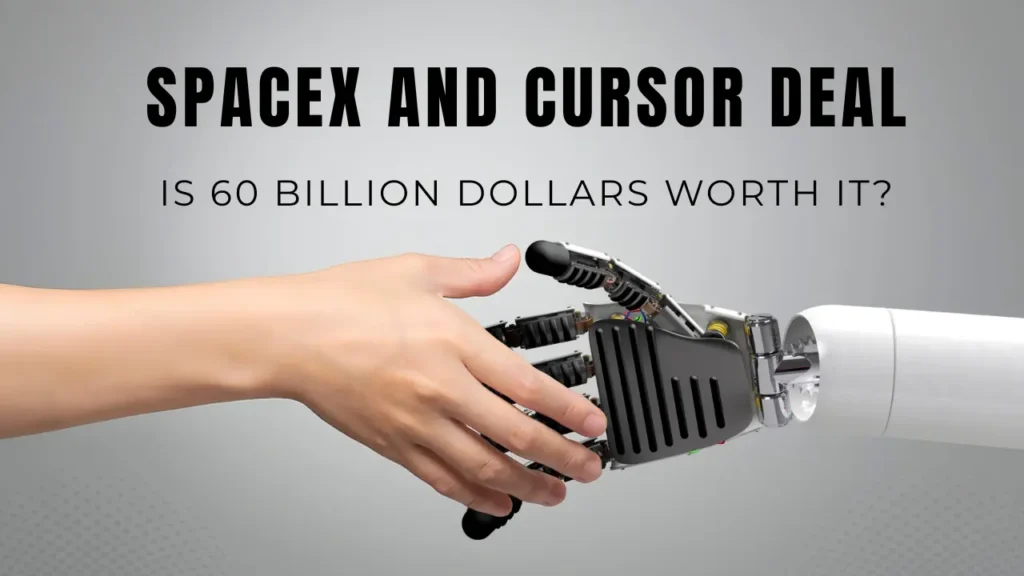
The biggest acquisition story in AI right now isn’t coming out of Silicon Valley’s usual suspects — it’s coming from the company that builds rockets. On June 16, 2026, SpaceX formally confirmed it is buying Anysphere, the parent company behind Cursor AI, in an all-stock deal worth $60 billion. The announcement landed just four days after SpaceX completed what became the largest IPO in stock market history. If you’ve been following the Cursor AI story — the coding tool that went from an MIT dorm-room idea to the editor of choice for developers at Fortune 500 companies — this deal is the next chapter, and it’s a big one.
Who Are the Cursor AI Founders?
Before getting into the deal itself, it helps to understand who built Cursor and how fast they moved. Cursor is made by Anysphere, a company founded in 2022 by four MIT students: Michael Truell (CEO), Sualeh Asif, Aman Sanger, and Arvid Lunnemark. Lunnemark departed in late 2025 to found his own AI research lab but the other three have stayed at the helm through the company’s explosive growth. The product was launched in March 2023.
Within two years, it had crossed $1 billion in annualized revenue. By June 2026, that figure had grown to roughly $2.6 billion in annualized business-to-business revenue — a number that reflects how deeply the tool had embedded itself inside real engineering teams. Cursor had already raised $900 million in a Series C in June 2025, followed by another $2.3 billion shortly after, with backing from Andreessen Horowitz, Thrive Capital, Nvidia, and Google. When SpaceX came knocking, Cursor was in talks to raise another $2 billion at a $50 billion valuation. The SpaceX deal effectively made that conversation irrelevant.
Michael Truell responded to the acquisition announcement with a post on X: “Excited to partner with the SpaceX team to scale up Composer. A meaningful step on our path to build the best place to code with AI.”
The Cursor AI and SpaceX Deal: What Actually Happened
This wasn’t a sudden approach. SpaceX had been circling Cursor since at least April 2026, when it first disclosed an unusual option agreement: it could either buy Cursor outright for $60 billion or pay $10 billion to work together in a partnership. At the time, Cursor said joining forces with xAI — SpaceX’s AI division — would give it access to xAI’s Colossus supercomputer facility in Memphis, Tennessee for training future models.
After its blockbuster IPO on June 12, 2026 (SpaceX raised approximately $75 billion and debuted at a valuation of over $1.77 trillion), SpaceX exercised the acquisition option. The deal is structured as an all-stock transaction — no cash changes hands. Cursor shareholders receive SpaceX Class A common stock, calculated at an implied equity value of $60 billion based on SpaceX’s volume-weighted average share price. The acquisition is being done by a SpaceX subsidiary called X67 Inc. and is expected to close in Q3 2026, subject to regulatory approval. If the deal falls through, SpaceX has agreed to pay Cursor a termination fee of $1.5 billion plus $8.5 billion in computing resources.
Upon closing, Cursor will become a wholly owned subsidiary of SpaceX, though the product itself is expected to continue operating under its own brand.
Why SpaceX Bought Cursor
It’s About the AI Race, Not the Rockets:
The honest answer is that SpaceX needed a credible AI product, and fast. When pitching IPO investors, SpaceX laid out an addressable market of $28.5 trillion — $26 trillion of which sits in AI enterprise applications. That’s an enormous promise to make. Delivering on it requires a product developers actually use every day, and Cursor had already built exactly that.
SpaceX merged xAI (Elon Musk’s AI startup) into itself in February 2026. xAI’s flagship product, Grok, had struggled to make a dent against the leading AI labs — Anthropic and OpenAI — particularly in coding. Buying Cursor AI was the fastest possible way to change that picture. As analyst Adam Crisafulli from Vital Knowledge put it, SpaceX is hoping “the Cursor team and product will give a jolt to its Grok AI business, especially in coding.”
The Data Advantage:
There’s a second layer to the deal that goes beyond revenue and market share: data. Every time a developer uses Cursor, the tool receives coding requests, context from their codebase, and feedback on which suggestions they accept or reject. That is a training signal that most AI labs would pay billions for. SpaceX’s IPO filing specifically called out Cursor’s access to developers’ data — including coding requests and design decisions — as a core asset that could help improve its AI models, including Grok.
Paying in Stock Was Smart Timing:
SpaceX’s share price surged more than 56% from its IPO price of $135 within days of going public, pushing its market cap past $2 trillion. By paying in stock at that valuation, SpaceX could acquire a $60 billion company at what amounted to roughly 3.4% dilution — a fraction of what this deal would have cost in cash. Investor Bill Ackman noted it plainly: “The Cursor acquisition costs materially less in dilution because of SpaceX’s high valuation.”
Read Also: ” How one laid-off engineer responded to the AI wave “
What Was Cursor’s Market Position Before the Deal?
It’s worth being clear-eyed about this. And just a few years ago, in mid-2025, Cursor was the leading AI coding tool, holding about 41% of the market share of AI-assisted coding platforms. By May 2026, that figure had fallen to roughly 26%, with Anthropic claiming approximately half the category. The growth that once looked unstoppable had slowed, and despite nearly $3 billion raised in funding, the company reportedly wasn’t on a clear path to breaking even.
None of that changes what Cursor built, but it does explain part of why the SpaceX deal made sense for both sides. SpaceX gets a product with genuine enterprise traction and millions of developer users. Cursor gets computing infrastructure, distribution, and the kind of backing that makes the next phase of model training possible.
What Happens Next: Origin and the GitHub Rivalry
The deal doesn’t stop at Cursor-as-editor. Reports surfaced around the time of the acquisition that SpaceX is preparing to launch a new code repository platform called Origin — positioned directly against GitHub, which Microsoft owns. If that materialises, SpaceX would be competing across the entire developer stack: AI coding assistant, code repository, and AI infrastructure underneath all of it. That’s a different kind of play than any single product acquisition, and it signals exactly the kind of vertical integration that SpaceX has already demonstrated in aerospace.
Read Also: “ ChatGPT vs Claude for coding which one to choose “
What Does This Mean for Developers Using Cursor?
If you use Cursor today, nothing changes immediately. The deal isn’t closed, and SpaceX has been clear that Cursor will continue operating as its own product. The near-term arrival of a jointly trained AI model — built on xAI’s Colossus infrastructure and designed to ship inside both Cursor and Grok Build — is the first concrete change to expect. Whether that model improves the daily experience of the cursor ai coding assistant remains to be seen, but the compute resources behind it will be considerably larger than what Anysphere could fund independently.
The bigger question for developers is loyalty. A meaningful part of Cursor’s appeal was its independence — it wasn’t tied to any single AI lab or cloud provider. Under SpaceX ownership, that neutrality becomes harder to claim. Some users will stay for the product. Others may look more seriously at alternatives. Either way, the AI code editor market just became considerably more competitive.
Frequently Asked Questions
Q1. Was Cursor bought by SpaceX?
Yes — SpaceX announced a formal $60 billion all-stock agreement to acquire Anysphere (Cursor’s parent company) on June 16, 2026, expected to close in Q3 2026.
Q2. Is Cursor worth $60 billion?
It was valued there by SpaceX, hinting at confidence in Cursor’s $2.6 billion in annualized revenue and its strategic importance in the AI coding race, even though Cursor’s market share was shrinking in early 2026.
Q3. What AI company did SpaceX buy?
SpaceX has recently acquired Anysphere, a startup company located in San Francisco, the developer of Cursor AI, which is a very popular AI-based code editor and coding helper.
Q4. Is Cursor owned by Elon?
Yet, the purchase has not been officially completed as the transaction is subject to regulatory approval and is forecasted to be finalized in Q3 2026. After the completion, Cursor will be a full subsidiary of SpaceX.